
I’ve been eagerly anticipating the acoustic analysis of Apple’s AirPods Pro Hearing Aid Feature since their release was announced in September 2024. Now, The Hearing Review has published a study conducted by the National Acoustic Laboratories, a research institution known for shaping clinical practices and advancing hearing aid technology. This study explores key performance metrics of the AirPods as OTC hearing aids, offering insights into their amplification capabilities and how they compare to traditional hearing aids.
In this study the researchers sought to measure the following:
Insertion gain: How much the device amplifies sound when placed in the ear.
Streaming gain: How well it delivers sound from sources like phones or TVs directly to ears.
Beamforming & signal-to-noise improvements: How effectively the device focuses on speech while reducing background noise for clearer listening.
For this blog, I am focusing on insertion gain as it directly impacts how well end users experience amplification and how clinicians assess the effectiveness of AirPods OTC hearing aids feature compared to traditional hearing aids. This measurement provides a clear benchmark for understanding sound delivery and real-world usability of these devices.
Insertion Gain Method
Using a head simulator, the AirPods were placed in the simulator ears and set up for a mild sloping hearing loss, a moderate sloping hearing loss and a flat mild hearing loss. The amplification settings were adjusted to be at the maximum allowed within the software. The researchers then performed real-ear measures to determine the level amplification (gain) the AirPods put into the ears of the simulator.
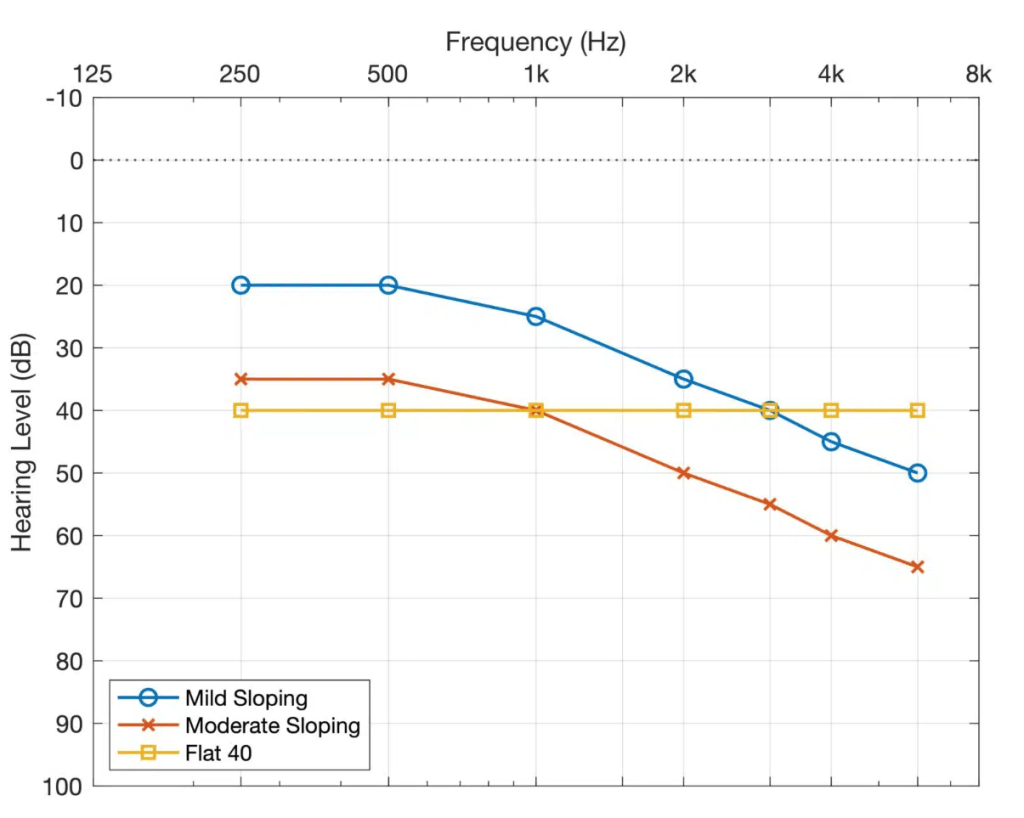
A screen shot from The Hearing Review depicting the hearing losses evaluated.
Real-ear measures are a way to make sure hearing aids are giving the right amount of amplification for each person’s unique ears. Since everyone’s ear shape affects how sound travels, Audiologists use small microphones placed in the ear canal to measure how much sound the hearing aid is actually delivering to the eardrum.
This process ensures the hearing aid is tuned properly, so the wearer hears speech and sounds clearly without things being too loud or too quiet. It’s a personalized way to ensure hearing aids work as effectively as possible and also a way to ensure there is enough amplification to meet the prescriptive hearing loss targets such as the industry standard NAL-NL2 targets used in this study.
OTC hearing aids are designed to be fit by the end user and have minimal customization options. I have been curious to see how they perform in the ear, Audiologically speaking. Let’s take a look at the results!
Results
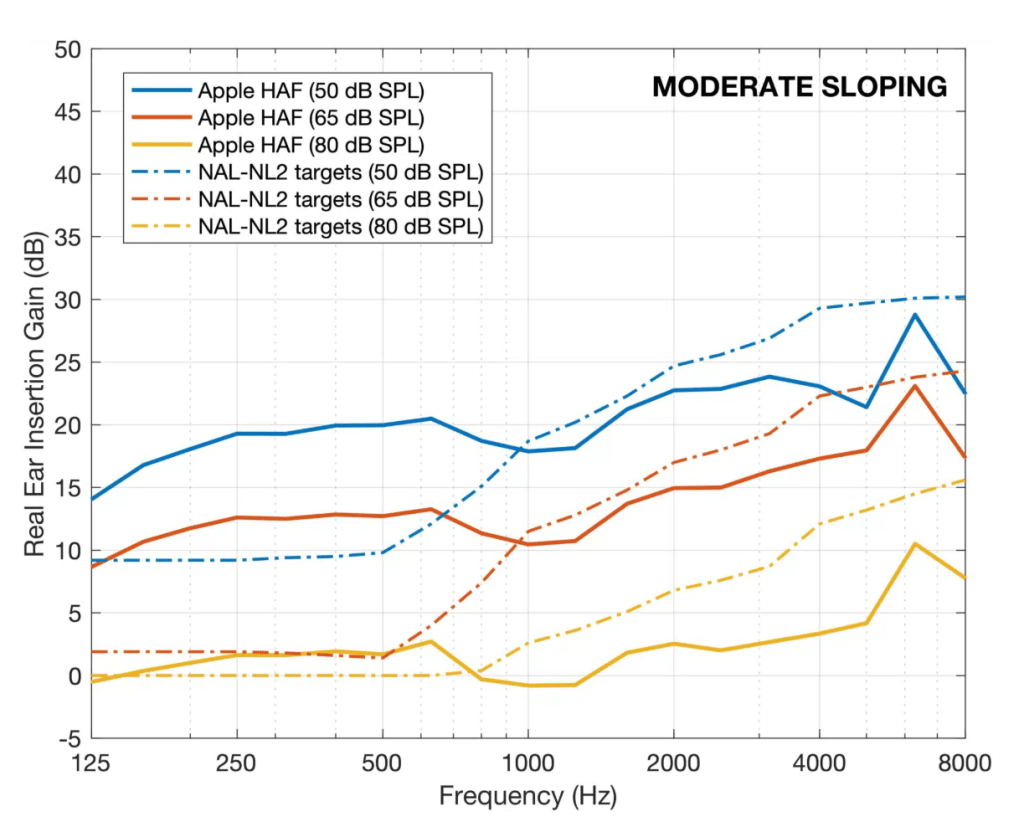
A screen shot from The Hearing Review depicting the gain to target for a Moderate sloping hearing loss.
What you see here is a visual representation of how much amplification the AirPods are putting in to the ear for a moderate hearing loss. Three different volumes of speech signal were played from a speaker in front the of head simulator. The solid lines represent the Insertion gain realized via the AirPods for soft (blue), average (orange) , and loud (yellow) inputs. The dashed line represents the prescriptive target, or how much gain there should be to meet the hearing aid prescription for the respective volumes. The solid line should meet the dashed lines within a few decibels of the targets for an ideal fit.
With traditional hearing aids, the Audiologist has the ability to fully adjust the insertion gain provided via hearing aid programming software, however with OTC hearing aids, this level of customization is not available.
What I immediately noticed when looking at these results is the amount of occlusion! If you look in the low frequencies (left side) on the moderate hearing loss graph, you will see the solid lines are far above the dashed lines! There is so much low frequency gain going in to the ear due to the fit of AirPods. This is going to cause the end use to sound very plugged up. The next thing I noticed, is the amount of under amplification there is for loud gain (yellow). You will see the solid line is below the dash line, meaning there is less gain than there should be. The orange (average volume) lines are close to target, all things considered, which would suggest fairly good amplification for average speech. I also noticed a “spike” in gain at about 6500 Hz which the researches explain: “The graphs also reveal peakiness between 6–8 kHz, potentially caused by resonance effects in the ear canal due to the shallow insertion depth of the AirPods Pro speakers.”

A screen shot from The Hearing Review depicting the gain to target for a mild hearing loss.
When looking at the graphs for a flat mild hearing loss, I also noticed the same excess gain in the low frequencies, again due to the closed fit of AirPods. There is also a significant upswing in gain as the frequency increase from about 6500Hz and above. This phenomena likely shares the same explanation as above.
I am pleased the gain so closely meets the NAL-NL2 targets 1000-5000Hz for soft, average, and loud inputs. This supports the AirPods ability to be suitable for the mild hearing loss, since they are approved for “perceived mild to moderate hearing loss”. I’m not sure how an end user could hear anything over all that occlusion though!
Based on these results, there are certainly limitations to the HAF in AirPods. According to the authors, “despite these constraints, AirPods Pro 2 serve as a valuable entry point into hearing care, fostering greater awareness and acceptance of hearing solutions. Future software updates could further enhance their features, improving their performance and expanding their appeal”
While the AirPods Pro Hearing Aid Feature presents some promising amplification for mild to moderate hearing loss, the data highlights key limitations—particularly in low-frequency occlusion, loud input amplification, and meeting overall prescriptive targets. These findings underscore the importance of personalized hearing care and adjustable insertion gain, which traditional hearing aids offer. That said, Apple’s entry into hearing assistance could help increase awareness and access for those exploring OTC solutions.
Chong-White, N., Croteau, M., Kitterick, P., & Edwards, B. (2025, April 9). Evaluating Apple AirPods Pro 2 hearing aid software: Acoustic measurements and insights. The Hearing Review. https://www.hearingreview.com/hearing-products/hearing-aids/otc/evaluating-apple-airpods-pro-2-hearing-aid-software-acoustic-measurements-and-insights.
 Dr. White, AuD